
It comes as an astonishment to many individuals that some taxable state benefits, for example, the state pension, are there in the taxable list.
You should be cautious since certain benefits, similar to Employment and Support Allowance (ESA) and Jobseeker’s Allowance (JSA) can be taxable in case they are paid dependent on National Insurance commitments you have made or can be non-taxable in case they are rather implies tried (in light of your monetary circumstance). Additionally, be cautious that receipt of certain benefits can influence professes to tax breaks or general credit.
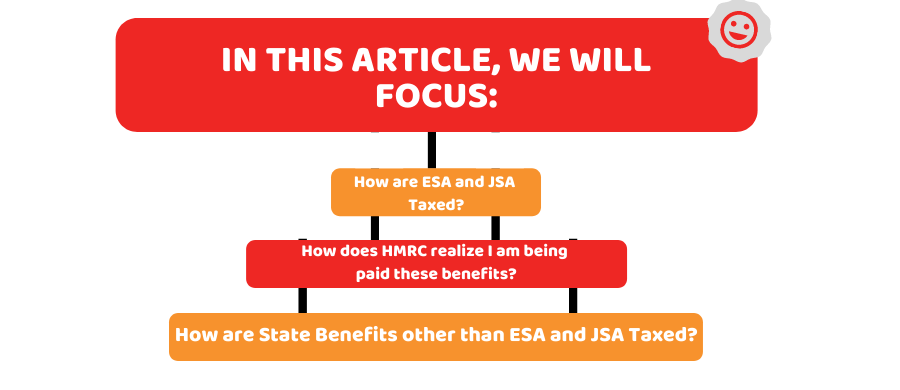
This article includes the following:
- How does HMRC realize I am being paid these benefits?
- How are State Benefits other than ESA and JSA Taxed?
- How are ESA and JSA Taxed?

How Does Hmrc Realize I Am Being Paid These Benefits?
For instance, DWP sends a day-by-day update to HMRC distinguishing individuals to whom it will begin paying an annuity, the week-by-week sum, and the date from which it is payable. Any progressions to the sum payable are prompted comparably.
There is a marginally unique framework to exhort HMRC when yearly augmentations occur, however, these are informed ahead of time for the new aggregate becoming payable. Extensively comparable frameworks work for taxable ESA and JSA.
Other taxable benefits don’t have such complex frameworks and we suggest you contact HMRC when you start getting any taxable state benefits to guarantee you don’t wind up with an unforeseen duty bill.
These frameworks rely upon your right National Insurance number is accessible with the goal that the records can appropriately connect.
How are State Benefits other than ESA and JSA Taxed?
There are extraordinary principles for burdening ESA and JSA that are clarified beneath.
Since the DWP doesn’t work PAYE on the state annuity and has numerous different benefits, this implies it likewise doesn’t give you the typical structures related to PAYE. In this way, you won’t get a structure P60 after the finish of the assessment year setting out how much state annuity you have gotten in the expense year. All things being equal, you ought to get a warning before the beginning of the duty year of what the week-by-week measure of your state annuity will be.
The sum that is taxable in that year isn’t the sum you have gotten in the expense year, rather it is the sum to which you are entitled in the duty year. The state annuity is paid financially past due and regularly on a four-week after-week premise yet you need to work out how long you were expected to accept your benefits.
Example:
Joni accepts her state benefits on a 4-week-by-week premise. Her taxable state benefits rate for 2021/22 is £179.60 each week. In 2020/21 the week-after-week rate was £175.20. For the reasons for this model, we accept the rate for 2022/23 is £184 each week.
In 2021/22, Joni gets the accompanying installments, at regular intervals on a Thursday:
- 15 April £709.60
- 13 May £718.40
- 10 June £718.40
- 8 July £718.40
- 5 August £718.40
- 2 September £718.40
- 30 September £718.40
- 28 October £718.40
- 25 November £718.40
- 23 December £718.40
- 20 January £718.40
- 17 February £718.40
- 17 March £718.40
Joni likewise gets an installment in 2022/23 on 14 April 2022 of £727.20.
Joni got £9,330.40 in 2021/22. Nonetheless, the principal installment included fourteen days identifying with 2020/21. Likewise, the main instalment received in 2022/23 included fourteen days identifying with 2021/22.
In this way, Joni ought not to be burdened on £9,330.40 for 2021/22 – the sum got during the assessment year. Joni ought to be burdened on £9,339.20 (52 weeks at £179.60) – the sum she is qualified for 2021/22.
If you have another type of income that is paid through PAYE, such as from employment or another standard UK pension payment, HMRC will attempt to collect the tax due on the state benefits or other taxable benefits by adjusting the tax code used by your employer or pension provider. You can find out more about this on our page ‘How do I check my coding notice?
Other taxable state benefits may not be remembered for coding sees, yet you can request that HMRC do that.
Some of the time it isn’t workable for HMRC to gather the entirety of the duty through your PAYE code and, in case that is the situation, they will reach you to organize an instalment of the extra assessment. This could be via a structure P800 or a straightforward appraisal.
If you have no other PAYE income, HMRC will collect any tax due on state benefits by issuing a simple assessment or, in other cases where you need to complete a Self-Assessment tax return, by collecting the tax due as part of the Self-Assessment calculation.
How are ESA and JSA Taxed?
In the first place, recall it is just commitments-based or recent fad ESA that is taxable. Pay-related (implies tried) ESA isn’t taxable. Also, just commitments based on recent trends JSA is taxable.
DWP (who pays these benefits) works an adjusted PAYE framework on these instalments. At the point when you claim one of these benefits, you need to give up any P45 you have gotten from a past boss. The P45 shows pay paid to date in the expense year just as assessment deducted from it. DWP will pay you everything of any benefits due, with no duty allowance or discount.
DWP will process your pay and tax details up to either the end of the tax year (5 April) or when you stop receiving the taxable benefit, whichever comes first. They will then make a tax refund, if applicable. If additional tax is due, DWP will notify HMRC, who will arrange to collect it.

Conclusion:
To conclude we can say that in case you are as yet getting taxable ESA or JSA toward the finish of an expensive year, DWP will give you a structure P60 showing aggregates paid to you by DWP during the duty year just as pay paid and charge deducted from past positions.
On the off chance that you quit asserting ESA or JSA during the assessment year, DWP will give you a structure P45 showing the totals paid to you by DWP during the duty year just as pay paid and charges deducted from past positions.
Disclaimer: This content includes general information on taxable state benefits.
