
Last updated: 14 October 2026
Since 1 April 2022, Making Tax Digital (MTD) for VAT has applied to every VAT-registered business, whatever its turnover. Exemptions are only available on limited grounds, such as age, disability or remoteness. Before we look at the rules, let’s define taxable turnover.
Taxable turnover is the total value of everything you sell that is not exempt from VAT, including zero-rated supplies such as many exports. Read on for the details of taxable turnover and Making Tax Digital (MTD).
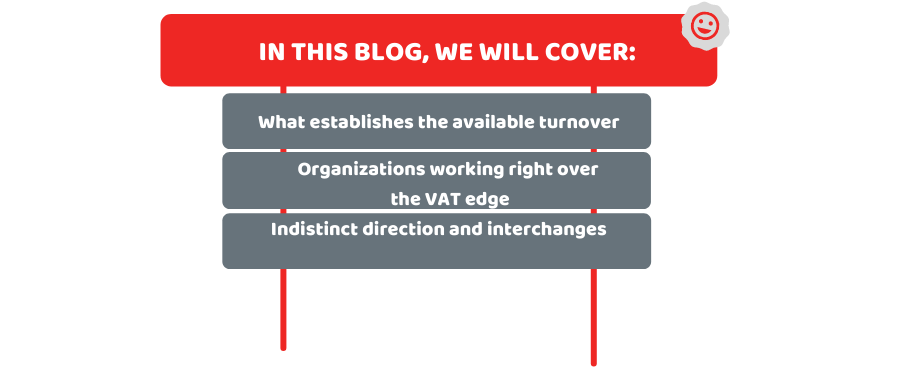
There is no turnover-based exemption from MTD for VAT. If you are VAT-registered, you must follow MTD unless HMRC grants an exemption on other grounds. This article covers three points:
- What counts as taxable turnover
- Businesses trading just above the VAT threshold
- Unclear guidance and HMRC letters

What Counts as Taxable Turnover
For VAT registration purposes, taxable turnover includes standard-rated, reduced-rated and zero-rated supplies. However, there are a few quirks:
The value of reverse charge supplies (i.e. services bought from overseas suppliers that are treated as supplied in the UK) also counts towards the VAT registration threshold. These include advertising and many professional services.
When working out whether you must register for VAT, one-off sales of capital assets are ignored. If you are not VAT-registered, MTD for VAT does not apply to you.
Since 1 April 2022, all VAT-registered businesses must follow Making Tax Digital for VAT, including those that registered voluntarily with turnover below the £90,000 threshold.
Supplies that are dependent upon a homegrown opposite charge, like discount supplies of gas and power and discount supplies of media transmission administrations, will likewise typically check towards the VAT limit. These sorts of supplies are not as a rule attempted by private ventures. Luckily, the worth of provisions inside the new homegrown Converse charge for specific supplies of development administrations.
Supplies that are outside the scope of UK VAT do not count towards the VAT threshold. These include supplies treated as made outside the UK (such as certain services to non-UK businesses) and income that is outside the scope of VAT altogether (such as donations).
Businesses Trading Just Above the VAT Threshold
If you started adding VAT on top of your prices when you registered, the position is likely to be straightforward: the value of your taxable supplies is easy to identify and, unless your turnover falls, will stay above the VAT threshold.
However, the position is more unusual for retailers and other businesses that absorb some or all of the VAT within their prices.
On an annualized premise this adds up to £79,992 ie beneath the VAT limit. In this way, even though the retailer turned out to be mandatorily VAT enlisted, knowing completely what is taxable turnover stays at these levels.
Could the retailer then deregister because its taxable turnover is below the £88,000 deregistration threshold? Unfortunately not: HMRC will not allow this unless the retailer can satisfy HMRC that it will reduce its prices by the VAT element.
Otherwise, the business would be caught in a loop of registering for VAT and then immediately qualifying to deregister.
Still unsure what counts as taxable turnover? Contact our experts for advice.
Unclear Guidance and HMRC Letters
When MTD for VAT was introduced, HMRC wrote to businesses it thought might be affected. For some businesses, it was not clear from their VAT returns whether taxable turnover was above the threshold.
HMRC therefore sent differently worded letters depending on whether it was sure the business’s taxable turnover exceeded the threshold at the time (then £85,000).
Since April 2022, every VAT-registered business must follow MTD for VAT, so any business that is VAT-registered should now be using MTD-compatible software.
To Avoid Further Confusion
Check what counts as taxable turnover for VAT registration. It may include transactions you were not expecting, or exclude ones you expected to include.
If the business is VAT registered but has a VAT-inclusive turnover below around £108,000 per annum, then it may still have a taxable turnover under £90,000.

Conclusion:
In summary, if your taxable turnover goes over £90,000 you must register for VAT, and every VAT-registered business, including voluntary registrations, must follow Making Tax Digital for VAT. We hope this article has helped.
