
Universal Credit is a monthly UK government benefit payment that is managed by the DWP to help with living costs. It replaces six older benefits with a single payment for people who are on a low income, self-employed, or out of work. For 2026/27, monthly standard allowances range from £338.58 to £666.97, before extra support or reductions.
This guide covers:
- What Universal Credit is,
- Who can get Universal Credit,
- What it pays in 2026/27,
- How to apply for Universal Credit,
- And much more…
And if you’d rather skip the reading and hand it all over, our specialist accountants in London at Accotax can help you understand your income position and point you in the right direction.

What is Universal Credit?
Universal Credit is a benefit payment from the UK government that helps with everyday living costs like rent, food and bills. It is a monthly payment from the Department for Work and Pensions (DWP). You get one payment a month which is paid after the month ends.
In Northern Ireland, payments normally arrive twice a month. Scotland also offers a twice-monthly payment option after your first payment.
Which Benefits Did Universal Credit Replace?
Universal Credit replaces six legacy benefits. The six benefits that have been phased out and replaced are:
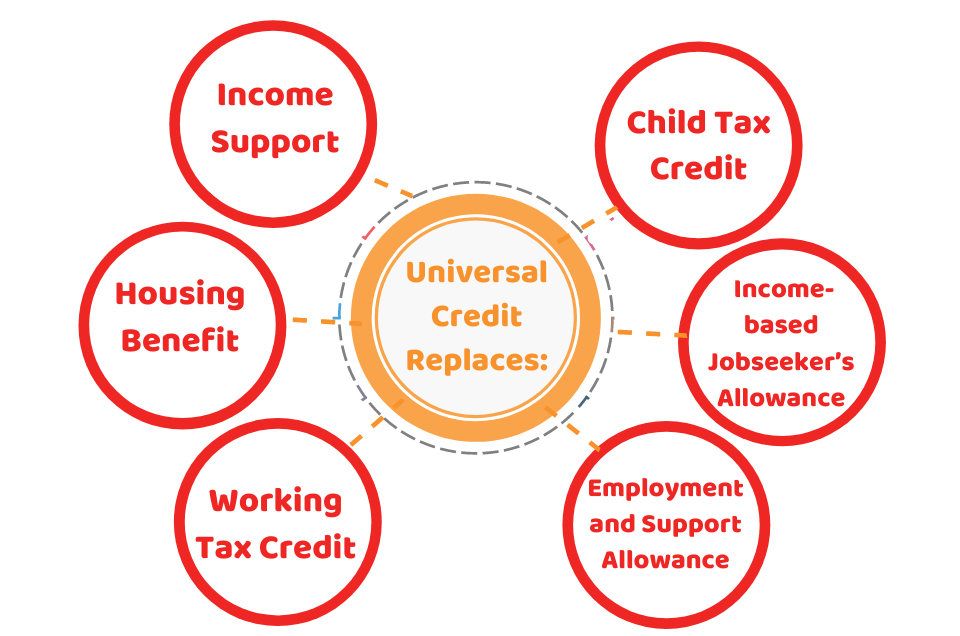
- Income Support
- Housing Benefit (except for certain temporary or supported accommodation)
- Working Tax Credit
- Child Tax Credit
- Income-based Jobseeker’s Allowance (JSA)
- Income-related Employment and Support Allowance (ESA)
They’re also known as the legacy benefits by the Department of Work and Pensions (DWP). If you’re already entitled to these benefits and tax credits, you don’t need to claim for UC.
The DWP will contact you when your benefits will be replaced by Universal Credit. If you’re the one making a new benefit claim, you need to claim for Universal Credit rather than other benefits.
How Much Universal Credit Do You Get In 2026/27?
How much Universal Credit you get depends on:
- your standard allowance
- any extra amounts that apply to you
- any money taken off your payment
- if you’re working, how much you earn
Generally, you get one standard allowance for your household.
| How much you’ll get | Monthly standard allowance |
| If you’re single and under 25 | £338.58 |
| If you’re single and 25 or over | £424.90 |
| If you live with your partner and you’re both under 25 | £528.34 (for you both) |
| If you live with your partner and either of you is 25 or over | £666.97 (for you both) |
On top of this, you might get extra for children (now expanded for larger families) or housing costs.
You can also check how much Universal Credit you could get by using a benefits calculator.
Who Can Claim Universal Credit?
You may qualify for Universal Credit if you need help with living costs, including when you work part-time, are self-employed or cannot work because of a health condition.
- Age: You must normally be 18 or older. However, 16- or 17-year-olds can claim in special circumstances (such as having a health condition, being a carer, or being estranged from their parents). You cannot claim if you have reached State Pension age (currently 66), unless you are in a mixed-age couple.
- Residency: You must live in the UK (or Northern Ireland). EU, EEA, or Swiss citizens typically need settled or pre-settled status under the EU Settlement Scheme.
- Income and Work Status: You can be out of work, unable to work due to a health condition or disability, or working (including self-employed) on a low income.
- Savings and Capital: Your household must have £16,000 or less in money, savings, or investments. Savings between £6,000 and £16,000 will reduce your monthly payment amount.
- Couples: If you live with a partner, you must make a joint claim for your household. Your partner’s combined income and savings will be factored into your entitlement.
Remember that meeting the basic conditions does not guarantee a payment. This is because your household finances still need to be assessed.
How Do Earnings Affect Universal Credit?
There is a misunderstanding among many people that you can’t receive Universal Credit if you are working. That is not true. You can work and still receive Universal Credit. And there is no fixed limit on the number of hours you can work.
Just remember that your payment generally reduces by 55p for every £1 of earnings counted under the rules. If you have children or a health condition that affects your ability to work, you may qualify for a work allowance. This lets you earn a certain amount before the reduction starts.
For 2026/27, the monthly work allowances are:
- £427 if your award includes help with housing costs.
- £710 if your award does not include help with housing costs.
These allowances apply only if you meet the relevant conditions.
Your payment is assessed monthly. Therefore, changes in pay dates, overtime or bonuses can affect what you receive in a particular assessment period. If your income changes, you need to check your Universal Credit statement.
Do You Pay Tax On Universal Credit?
No, Universal Credit is completely tax-free. So, you do not have to pay income tax on Universal Credit. You also do not need to report it to HMRC.
How Do You Apply for Universal Credit?
Most people apply online through the official government website.
- Visit GOV.UK to apply for Universal Credit.
- Create an account and complete your application.
- Provide details about your identity, household, housing costs, income and savings.
- Attend an interview or complete any further steps requested by the DWP.
- Read your claimant commitment and keep your online account up to date.
You will usually receive your first payment about five weeks after making a claim. An advance payment may be available if you need help before your first payment. But it must be repaid from future benefits.
Use the official website to check the latest application process and what documents you need.
How Accotax Can Help
Claiming Universal Credit while working or running a business can leave you with questions about income, expenses and tax. Accotax can help you keep your bookkeeping organised, prepare accounts and manage your tax returns.
If you are self-employed, we can also explain which business expenses may be allowable for tax purposes and help you understand your reporting responsibilities.
Get in touch with us today to discuss the support you need.

The Bottom Line
Universal Credit is a payment to help with your living costs. The amount you receive depends on your circumstances.
Remember that if you are working, it does not automatically mean you lose your entitlement. Also know that Universal Credit is tax-free, but your wages or business profits may still be subject to tax.
Do not forget to get professional advice if you are unsure how your business income affects your tax position.
Disclaimer: All the information provided in this article on “What Is Universal Credit? A Simple UK Guide for 2026/27” including all the texts and graphics, is general in nature. It does not intend to disregard any of the professional advice
