
Running a business in the UK has become more digital and more regulated over the last few years. This makes limited company accountant fees a significant part of your annual budget. Generally, you can expect to pay anywhere from £80 to £250 per month for a standard service. If you prefer paying annually, the cost of limited company accounts usually sits between £600 and £2,500. Ultimately, the actual costs depend on how much work you need them to do. Running and managing a business has never been easy. There are a lot of challenges that most business owners face. One of those challenges is managing overhead costs, especially for SMEs that have limited resources.
Among others, limited company accountant fees can be a costly overhead for small businesses. For this reason, in this blog, we’ll be discussing why your limited company needs an accountant, and how much the limited company accountant fees are.
You’ll get to know:
- Factors that affect the cost of an accountant for a Limited Company
- Can you do your own accounts?
- Do accountants charge extra for advice?
- And much more…
Let’s get into it!

What are the Average Limited Company Accountant Fees?
When looking at the cost of an accountant in the UK, you’ll find that most firms have moved toward monthly subscription models. This helps with your cash flow, and it also ensures your records are kept up to date throughout the year.
- Micro-Entities and Solo Directors: If you have a low volume of invoices, expect accountant fees for limited companies to be around £80–£120 per month. This usually covers your year-end accounts, corporation tax, and one director’s self-assessment.
- Small Businesses (1-10 employees): As you grow, the accountant cost for small business needs increases. For a company with a small team and VAT registration, you are looking at £150–£300 per month.
- Established Limited Companies: For those with higher turnover and complex payroll, the typical costs of an accountant for a limited company can exceed £400 per month.
Ultimately, the limited company accountant fees depend on the services included and also the complexity of the company’s finances.
Factors That Affect the Cost of an Accountant for a Limited Company
The limited company accountant fees can vary significantly between businesses. This is because accountants usually calculate their fees based on the amount of work required.
Here are the main factors that affect limited company accountant fees:
1. Turnover and Number of Transactions
A limited company with 20 invoices a month and one bank account is relatively straightforward to manage. However, the workload increases significantly for companies with multiple income streams, various bank accounts, and hundreds of transactions every month.
Higher turnover usually means more transactions. More transactions mean more checking, adjustments, and analysis.
That extra work is a big driver behind accountant fees for small business clients.
2. VAT Registration Status
VAT registration status is another primary factor that increases limited company accountant fees. When you register for VAT, your accountant’s workload increases. They must now manage your quarterly (or monthly) submissions to HMRC.
This status also impacts the limited company accountant cost due to the technical requirements of “Making Tax Digital” (MTD) for VAT. Your accountant requires digital record-keeping and submission through compatible software.
Beyond the extra filings, your VAT scheme choice, such as the Flat Rate, Cash, or Accrual schemes, can also impact the cost of an accountant in the UK.
Ultimately, the limited company accountant fees will be higher for VAT-registered businesses because of the ongoing administrative burden.
3. Payroll and Number of Employees
Payroll requirements are a significant factor that can increase limited company accountant fees. Key elements that drive up these fees include:
- Employee Count: Most accountants charge a base fee plus an additional amount per payslip. This often ranges from £5 to £15 per employee per month.
- Pension Auto Enrolment: Managing workplace pensions adds a layer of time-consuming compliance. This includes employee assessments, opt-ins, and contribution uploads.
- HMRC Reporting: Accountants must submit Real Time Information (RTI) filings every time staff are paid. This ensures PAYE and National Insurance are correctly recorded.
- Variable Pay and Benefits: Processing bonuses, statutory sick pay, or maternity leave requires extra manual work and specialised knowledge.
Because of these recurring requirements, the cost of limited company accounts is generally higher for businesses with staff than for those without.
4. Industry and Complexity
Some sectors are more complex than others. For example:
- Construction (CIS, subcontractors, reverse charge VAT)
- Hospitality (tips, tronc arrangements, stock and multi‑rate VAT)
- Medical or professional services (regulation and insurance angles)
If your business sits in a more complex or heavily regulated sector, limited company accountant fees in that space will often be higher. This is because there is more to get right.
5. State of Your Records
The limited company accountant fees for your company will also depend on how tidy things are when they land on the accountant’s desk:
- Clean, reconciled records in a cloud system usually mean lower fees.
- Mixed personal and business spending, or half‑finished spreadsheets, usually mean more work. This results in higher costs.
Using software like Xero, QuickBooks or FreeAgent, and keeping on top of your records during the year, is one of the easiest ways to keep limited company accountant fees under control.
Why Do You Need an Accountant for Your Limited Company?
Here are the primary reasons why an accountant is essential for most limited companies:
- Tax Efficiency and Savings: An accountant understands complex tax laws and can identify allowable expenses or tax reliefs you might miss. This often reduces your tax bill by more than the actual limited company accountant fees.
- Compliance and Accuracy: HMRC and Companies House have strict rules for statutory accounts. An accountant ensures your “Company Tax Return” (CT600) and “Statutory Accounts” are accurate. As a result, you’ll be able to avoid costly late filing penalties or investigations.
- Expert Advice: Beyond just filing forms, a professional provides guidance on the most tax-efficient way to pay yourself through a mix of salary and dividends. This advice is a key part of the value included in the limited company accountant fees.
- Managing Deadlines: Managing deadlines matters because late filings or payments can lead to penalties or interest. An accountant keeps track of your financial calendar so you never miss a VAT or Corporation Tax payment date.
- Business Growth: By outsourcing the bookkeeping and technical filings, you free up dozens of hours each month. This allows you to focus on running your business rather than worrying about spreadsheets and tax codes.
How much are the Limited Company Accountant Fees?
Well, there is no standard for limited company accountants as it varies based on multiple factors. These factors may be the annual turnover, size, staff, and the complexity of the accounts.
In addition, one of the other factors that affect the accountancy fees is how much your accounts are organised. If they are organised, then an accountant will take less time to analyse your finances and charge less.
For this reason, we recommend you keep your books in order using the latest accountancy software.
Getting the help of an accountant takes the financial burden off your shoulders; however, you need to know that the fee of a limited company accountant is higher than that of a common accountant.
On an average basis, the limited company accountant fees start at £150-300 a month. These include the following services:
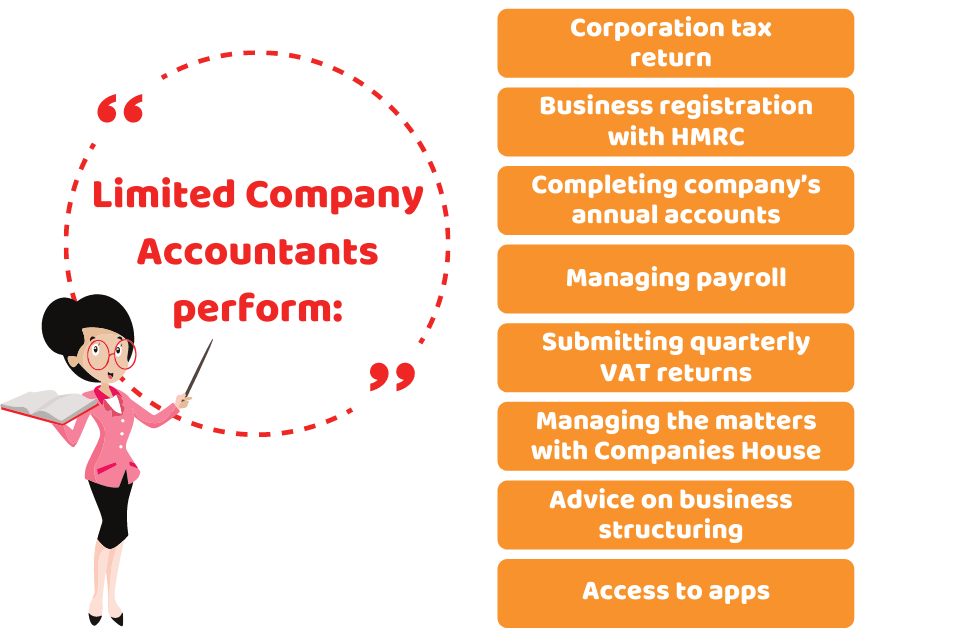
- Corporation tax return
- Business registration with HMRC
- Completing your company’s annual accounts
- Managing payroll and any other staff members
- Submitting quarterly VAT returns (if you are VAT registered)
- Managing the matters with Companies House
- Advice on business structuring or company setup
- Access to apps
The packages mentioned are for those companies that are just starting out or SMEs. For additional services, you need to be ready to pay more.
Typically, an average of £200 a month will cost you to get the services of an accountant for the following tasks:
- Completing tax returns for employees
- Quarterly account management and planning
- Processing payments to HMRC
- Employment contracts
- Fee protection insurance
Can You Do Your Own Accounts?
Yes, you can legally do your own accounts as a director of a limited company. There is no law requiring you to hire a professional. However, you remain personally and legally responsible for the accuracy of all filings, even if you do them yourself.
What you can realistically do yourself
Many limited company directors can comfortably handle:
- Basic bookkeeping: recording income and expenses, reconciling bank transactions.
- Invoicing and chasing payments.
- Organising receipts and using apps to capture them.
If you are organised and comfortable with numbers, doing your own bookkeeping can reduce accountant fees for limited companies. This is because your accountant will spend less time tidying up.
Where it gets risky
Where things get riskier to handle completely alone is:
- Preparing statutory year‑end accounts in the right format.
- Completing the Corporation Tax return correctly.
- Making sure director loans, dividends and salaries are treated properly.
- Handling more complex areas like VAT, capital allowances, the merged R&D relief scheme, or tax-efficient company vehicles.
The financial penalties and stress if something goes wrong can quickly outweigh the savings you might make on limited company accountant fees.
Hiring a Limited Company Accountant: Additional Fees to Look Out For
When comparing limited company accountant fees, it is important to check what is not included in the base price. Many firms charge extra for “sundry” services that can add up over the year.
Common additional costs include:
- Registered Office Service: Using the accountant’s address as your official business address.
- Confirmation Statement Filing: The annual fee paid to Companies House (currently £50 for digital filing) plus the accountant’s admin fee to file it.
- Fee Protection Insurance: A policy that covers the accountant’s costs if HMRC launches a tax enquiry into your business.
Checking these details upfront ensures that the limited company accountant cost you are quoted is the actual price you will pay.
Can I Change Accountants Mid-Year?
Yes, you can. If you’re unhappy with your current accountant, you’re free to switch. The process usually involves informing your old accountant, appointing a new one, arranging a handover of records, and authorising the new accountant to deal with HMRC on your behalf.
Many firms, including Accotax, handle the transition smoothly. So if you feel you’re paying too much or not getting the service you need, don’t wait until year-end.
Do Accountants Charge Extra for Advice?
It depends on how your agreement is set up. Some accountants include basic advice within their standard limited company accountant fees. However, if you need deep, specialist work like inheritance tax planning, complex restructuring, or help with a mortgage application, most will charge an extra project fee or an hourly rate.
It’s worth clarifying upfront what’s included in your monthly fee and what counts as “advisory” work that might be billed separately.
Why Do Some Firms Charge Much Less Than Others?
When you see one accountant charging half of what another charges, it’s usually not because one is generous and the other isn’t. There are real reasons behind the difference. Low-cost firms often use a “volume-based” model where they automate most tasks and provide less one-on-one time.
More expensive firms typically offer a dedicated accountant who understands your specific industry. The key is to look at value, not just price: are you getting a basic “file and forget” service, or a proper finance partner for your business?
If a price seems unusually low, check if they are qualified accountants or if they charge extra for “essentials” like software subscriptions or registered office addresses.
How Much Does an Accountant Cost for Small Business?
The cost of an accountant for a small business varies widely. However, simple services may start from around £50 to £150 per month, while limited companies often pay more depending on the level of support included. If you need more support, like VAT returns, payroll, and bookkeeping, the cost can rise to around £250–£450 per month.
However, the exact fee depends on the size of your business and the complexity of your records. It also depends on whether you choose a local practice or an online accountant.
Is It Cheaper to Pay Annually Rather Than Monthly?
In many cases, the overall cost is similar whether you pay annually or monthly. However, most business owners prefer monthly payments due to two main benefits: it smooths out their cash flow, and it encourages more regular contact with the accountant.
If you do have the cash available, you can always ask whether there is a reduced rate for paying annually. If not, choosing between annual and monthly is primarily about what suits your cash flow and how you like to budget.
Will My Fees Increase as My Company Grows?
Most likely, yes. As your company grows, there is usually more work for your accountant to do. More sales often mean more invoices and transactions, more suppliers, possibly VAT registration, additional bank accounts, and perhaps a growing team on payroll.
All of that takes extra time to manage properly, and limited company accountant fees will normally reflect that. Therefore, it’s sensible to budget for higher fees as your company expands.
Do I Have to Pay Extra for VAT or Payroll?
In many accounting packages, VAT and payroll are separate services. This means the limited company accountant fees may increase if your company becomes VAT-registered or hires employees.
VAT-registered companies must submit digital returns through MTD-compatible software, usually every quarter. Preparing and reviewing these submissions adds extra work, which increases the limited company accountant cost.
Payroll services also require additional reporting to HMRC. Even for small teams, payroll involves PAYE submissions, pension contributions, and employee records. Because of this extra responsibility, many accountants charge an additional monthly fee for payroll services.
Before choosing an accountant, it is helpful to ask whether VAT returns and payroll are included in the quoted limited company accountant fees.
Is It Worth Paying an Accountant for a Limited Company?
Some directors initially try to save money by filing accounts themselves. However, mistakes can become expensive.
Common issues include:
- Claiming the wrong expenses
- Missing filing deadlines
- Incorrect VAT submissions
- Inefficient salary and dividend structure
A good accountant often saves more money in tax planning than their actual fee.
This is why many UK directors see the cost of an accountant in the UK as a valuable business investment.
Can I Negotiate Accountancy Fees?
You can definitely negotiate your fees, but the best way to do this is by reducing the accountant’s workload. If you use cloud software like Xero or QuickBooks and keep your records perfectly organised, the accountant spends less time fixing errors. This gives you leverage to ask for a lower rate.
Are Accountant Fees Tax-Deductible?
Yes, they are! Because accounting is a necessary business expense, you can claim the full cost of the fees against your profits. It will reduce your overall Corporation Tax bill.
For example, if your company pays the small profits rate of Corporation Tax (currently 19% for profits up to £50,000), every £100 spent on allowable accountant fees could reduce your tax bill by £19. Note that the exact saving depends on your company’s specific Corporation Tax rate.
Do I Need an Accountant if My Limited Company is Very Small?
You are not legally required to hire an accountant for a very small limited company in the UK. You can manage accounts yourself. However, an accountant is highly recommended to handle complex tax and ensure compliance with Companies House and HMRC. This often results in saving more than the limited company accountant fees.
Accountants also help you spot tax reliefs you might miss and give guidance as your business grows. So even if your company is small, an accountant can provide peace of mind and free up your time to focus on running the business.
What Are the New Reporting Rules for 2026?
For accounting periods starting on or after 6 April 2025, the thresholds for micro-entities and small companies will increase. The turnover limit for a micro-entity is expected to rise to around £1 million (subject to final implementation). This means more businesses can now use simpler “micro” accounts, which can help keep limited company accountant fees lower.
How Does MTD for Income Tax Affect My Fees?
Starting in April 2026, the new ‘MTD for Income Tax‘ rules might affect your fees. If you earn over £50,000 from personal rent or a side business, you’ll have to file five digital updates a year instead of just one.
Because this is a lot more work, many accountants are increasing their personal tax fees for 2026/27. It is worth checking now if your current package covers these extra filings or if you’ll need to pay more for the new software.
The Bottom Line
In the UK, limited company accountant fees range from around £80 a month for small businesses to several thousand pounds annually for full‑service support. The exact cost depends on your company’s size, the services you need, and whether you choose a local practice or an online firm. The important thing is to see accountant fees as an investment in your business rather than just an expense.

How Can Accotax Help with Your Limited Company Accounting Needs?
At Accotax, our limited company accountants focus on what small UK businesses actually need. We support you with annual accounts, corporation tax returns, bookkeeping, payroll, VAT, and day-to-day accounting queries, all in one place.
Whether you want to incorporate a company or need to work out its taxes and accounts, let our limited company accountant at Accotax do the hassle for you. Our limited company accountants at Accotax will leave no stone unturned to squeeze out the cash for you.
Once you have us on board, expect us to do all the paperwork for you.
We offer inclusive accounting packages for your limited company, but we’d love to tailor them to your needs if you are looking for customized services. Our limited company accounting services include:
- Filing the Company’s Annual Return and Abbreviated Set of accounts to the Companies House every year,
- Pay any Corporation Tax due within 9 months and one day after the year-end date.
- File a full set of Accounts with HMRC every year. ( To be filed within 12 months after the year-end date)
- File the Company Corporation tax return to HMRC- CT600 ( to be filed within 12 months after the year-end date).
- Register your business for VAT if turnover is above the VAT threshold, or you can register voluntarily.
- File VAT returns usually quarterly, but only if you are VAT registered.
- If you have employees, you should set up a PAYE system to collect income tax and National Insurance contributions.
- File your monthly payroll under real-time information. Only when you have a PAYE scheme in place.
- File Self-assessment tax returns every year as a director of the company. ( Only when you take a salary or dividend from the company)
- Other Requirements, depending on individual circumstances, such as filing P11D, etc.
Our limited company packages start from as per your annual turnover and business needs. We hope, after reading this post, you have got a better understanding of the topic.
Disclaimer: The information about How Much is the Limited Company Accountant Fees? provided in this article including text and graphics. It does not intend to disregard any of the professional advice.
