
Running a business in the UK comes with plenty of admin bookkeeping, tax returns, HMRC letters landing in your post. And if you are VAT registered you already know how much extra responsibility it brings. But what happens if you decide you no longer need to be VAT registered? Or maybe HMRC says you must cancel your registration. That is where VAT deregistration comes in.
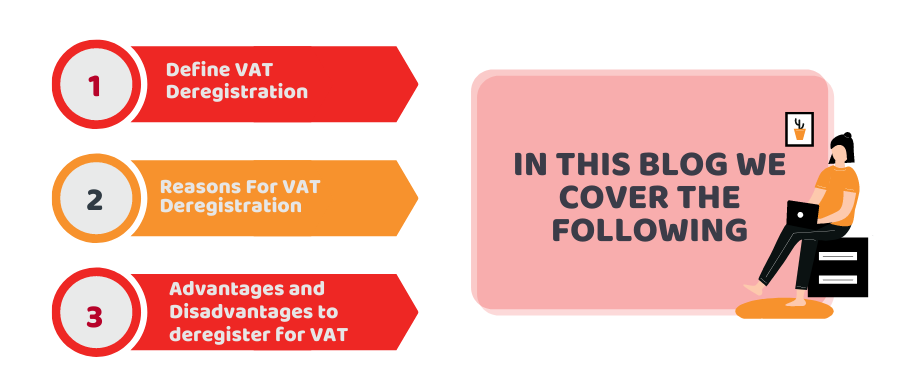
If you have been wondering what VAT deregistration actually means, you need not worry, as in this guide, we’ll cover:
- What Does It Mean To Deregister For VAT,
- Why Would A Business Deregister For VAT
- Pros And Cons To Deregister For VAT, And
- Much More…
Let’s get started!

What Does It Mean To Deregister For VAT?
VAT deregistration simply means cancelling your VAT registration with HMRC. Once you deregister for VAT, you do not charge VAT on your sales and you cannot reclaim VAT on your purchases anymore. It is like stepping out of the VAT system altogether. Your business can still trade but VAT is no longer part of your pricing, invoicing or accounting, unless you register again in the future!
Why Would A Business Deregister For VAT?
Deregistering for VAT is not always a negative step. In the UK, there are generally two main routes that lead to VAT deregistration: voluntary deregistration and compulsory deregistration.
Let’s break them down:
1. Voluntary VAT Deregistration
Sometimes a business may choose to deregister for VAT even when it is not required to. This is known as voluntary deregistration.
- Turnover drops below the threshold: If your taxable turnover falls below the VAT deregistration threshold which is currently £88,000 in the UK, you can apply to HMRC to deregister. Many small businesses take this step when their income stabilises at a level where charging VAT no longer makes sense.
- Simplifying admin: VAT returns can be time consuming and stressful. For sole traders or very small businesses removing the requirement to file quarterly VAT returns can reduce admin.
- Avoiding uncompetitive pricing: If most of your clients or customers are not VAT registered themselves then charging VAT will make your services appear more expensive. By deregistering, businesses might be able to offer more competitive prices.
- Cash flow relief: Sometimes, businesses struggle with the timing of VAT payments. While you may be reclaiming VAT on expenses, the upfront responsibility to collect and pass on VAT to HMRC can affect cash flow. Deregistering removes that burden.
That said, voluntary deregistration should always be carefully considered. For example, if you plan to expand your business soon, staying VAT registered may be more beneficial long term.
2. Compulsory VAT Deregistration
In other situations, HMRC may require a business to deregister. This is known as compulsory deregistration.
- Ceasing to trade: If your business stops trading or you are closing down permanently, in that case you must cancel your VAT registration.
- Changing business activities: If you stop making taxable supplies you cannot stay VAT registered as per HMRC. For instance if you shift to offering only exempt services like financial or medical services then HMRC will expect you to deregister.
- Selling or passing on your business: If you hand over your business to someone else, you may need to cancel your VAT registration. However, if the new owner keeps the same VAT registration number under what’s called a “transfer of going concern” arrangement, then cancellation might not be needed.
- Moving your business outside the UK: If your business no longer has a permanent base in the UK or stops supplying taxable goods or services here, HMRC will expect you to deregister for VAT.
Compulsory deregistration is not a choice unlike voluntary deregistration. It is a legal requirement and failing to act on it can lead to penalties.
How To Cancel Your VAT Registration (Step By Step)
Here is what the process looks like in practice:
- Check your eligibility
Make sure you meet the conditions for deregistration. - Apply to HMRC
- Online: Log in to your Government Gateway account.
- By post: Complete form VAT7 and send it to HMRC.
- Submit your final VAT Return
HMRC will ask you to complete a final VAT return covering the period up until your deregistration date. - Account for business assets and stock
If you still hold assets or stock worth more than £5,000 (including VAT), you may need to pay VAT on them. - Wait for confirmation
HMRC will send a letter confirming the cancellation date. Keep it for your records.
How Long Does The VAT Deregistration Process Take?
The VAT deregistration process usually takes around three weeks. It might take a little longer if HMRC asks for extra information. In the meantime, you will need to keep following VAT rules until you are officially deregistered.
When Will Your VAT Registration Be Cancelled?
HMRC usually cancels from the date:
- Your application is approved (for voluntary deregistration).
- Your business ceased trading or became exempt (for compulsory deregistration).
They will confirm this date in writing, so you know exactly when to stop accounting for VAT.
Your Responsibilities After VAT Deregistration
Even after HMRC confirms, you still have a few obligations:
- Submit the final VAT return.
- Keep your VAT records for at least 6 years.
- Stop charging VAT on invoices.
- Do not claim VAT on purchases after your deregistration date.
Reclaiming VAT After Deregistration
You might still be able to reclaim VAT on certain purchases or services received before deregistration, as long as they relate to your business’s taxable activities while you were registered.
This needs to be included in your final VAT return.
What Happens To Business Assets During VAT Deregistration?
If you still own assets or stock when you deregister, you may need to account for VAT on them provided their total value (including VAT) is over £5,000.
This is HMRC’s way of making sure VAT is not unfairly avoided if you later use those assets privately or outside the VAT system.
Can I Transfer My VAT Registration?
Yes, if you sell your business as a going concern, you can transfer the VAT registration to the new owner. This is known as a Transfer of a Going Concern (TOGC).
It saves the new owner from re-registering and keeps things smoother with HMRC.
What If You Should Not Have Cancelled Your VAT Registration?
If HMRC finds that you cancelled by mistake or were not actually eligible, they can backdate your VAT registration. That means you will owe VAT for the period you should have been registered.
This can be costly, so always double-check your eligibility before applying.
Advantages and Disadvantages To Deregister For VAT:
Like any other business affair, VAT deregistration comes with its pros and cons. Let’s start with the pros first.
Pros Of Deregistering:
- VAT receipts are no longer need to be recorded.
- You are free from account updates on a quarterly yearly basis.
- VAT returns and submissions are no longer required.
- It is easy to attract more and more clients by charging less than VAT-registered companies.
- The customers will more probably be happy to maintain the same VAT-inclusive prices.
- Protect yourself from taking over the threshold and enjoy.
Cons Of Deregistering:
- You can’t claim VAT on purchasing products.
- Large organizations would be less interested in doing business with you as they will take you as a small business.
- The accountants who used to handle this department will be handled less professionally.
- You will be required to maintain records every month to avoid any ugly mishap in the future.
Re-Registering For VAT
HMRC has the power to put your business back on the VAT register if they find out that deregistration shouldn’t have gone through. In that case, you’ll be expected to pay the VAT that would have been due during the period you were off the register.
If later on your business becomes liable for VAT again or you choose to sign up voluntarily after cancelling, you can apply for a new registration online. Just note that HMRC will issue a fresh VAT number, the old one won’t be reactivated.

The Bottom Line
To give final thoughts to the discussion of deregistering for VAT, we can say that it is a complex business affair. It comes with its factors that are advantageous too. However, deregistering can seriously affect the growth of your business. To avoid compelling situations, it is wise to seek advice from professionals.
Disclaimer: All the information provided in this article on VAT deregistration, including all the texts and graphics, is general in nature. It does not intend to disregard any of the professional advice.
