
If you are renting a commercial space as a small business, you may need to customise it as per your business needs. The change or improvement you made to enhance the rental property is called leasehold improvement.
In this guide, you will learn what leasehold improvements are and how to record them in your books. Read on till the end to find out!

What Are Leasehold Improvements in Commercial Property?
Also known as tenant improvements, it may refer to the alterations, additions, or installations made to customise a rental property as per the needs of the tenants. Here are some of the examples of these improvements:
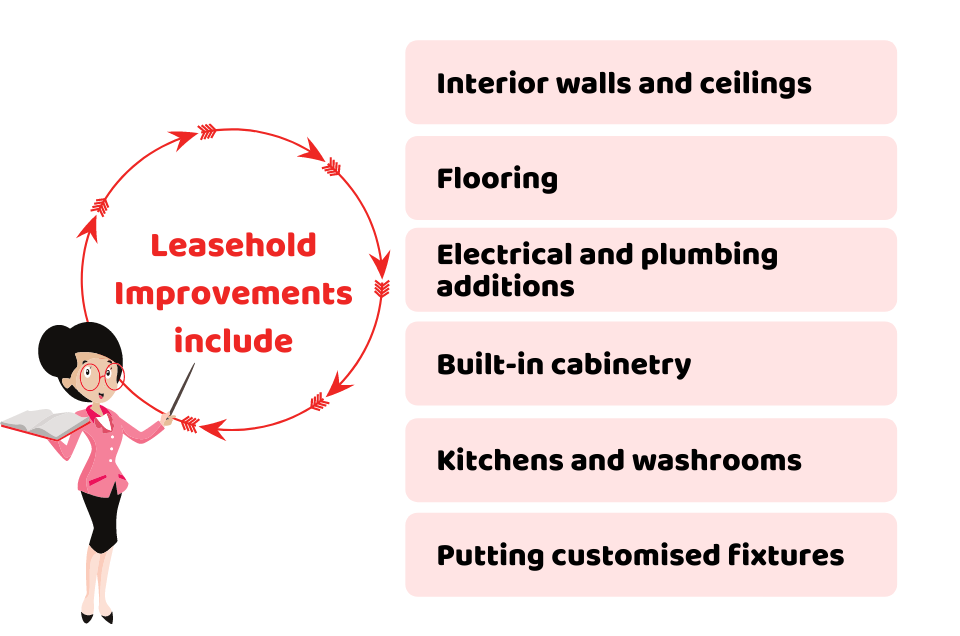
- Interior walls and ceilings
- Flooring
- Electrical and plumbing additions
- Built-in cabinetry
- Kitchens and washrooms
- Putting customised fixtures
These improvements are generally made by a tenant or a landlord, and most of the time, they are paid for by the tenant. Normally, the useful economic life of such improvements is 5 to 10 years. So, you need to work out amortisation as per the economic life of the rental space.
Types of Leasehold Improvements
Leasehold improvements fall into several categories depending on the nature of the property, the industry and the needs of the tenant.
1. Structural Improvements
These involve permanent changes to the property’s interior structure. For example:
- Installing or moving walls and partitions
- Reinforcing flooring to handle heavy equipment
- Upgrading ceilings or stairways
Structural improvements are usually fixed and cannot be easily removed. Since they often extend the property’s useful life, they may be subject to stricter depreciation rules.
2. Electrical and Mechanical Systems
Modern businesses often need more than what the base property provides. Improvements may include:
- Upgraded lighting systems
- Additional power points or data cabling
- Heating, ventilation and air conditioning (HVAC) installations
- Enhanced security systems (alarms, CCTV, entry access)
These improvements directly support daily business operations and usually count as capital expenditure.
3. Interior Finishes and Fixtures
These are the most common types of leasehold improvements. It includes:
- New flooring (tiles or carpets)
- Painting and plastering walls
- Installing counters or reception desks
- Built in cabinets or storage spaces
Although some of these items may seem minor they still count as improvements if they become part of the property and cannot be removed without damage.
4. Specialised Business Fit-Outs
Industry specific businesses often require highly tailored improvements which include:
- Commercial kitchens in restaurants
- Treatment rooms in dental practices or clinics
- Changing rooms or shower facilities in gyms
- Soundproofing for studios
These improvements are essential for the business model and can involve significant upfront costs.
5. Accessibility and Compliance Upgrades
Sometimes improvements are made to ensure compliance with UK building regulations or health and safety standards. For example:
- Installing wheelchair ramps or lifts
- Improved washroom facilities
- Fire safety systems
- Emergency exits
Even though these changes may be legally required, they are still classed as leasehold improvements and depreciated accordingly.
What Is the Difference Between Leasehold Improvements and Repairs?
It’s worth noting that improvements increase the property’s value (capitalised & depreciated), while repairs restore the property to its original condition (deductible as an expense).
Example:
- Replacing broken lights = repair (expense).
- Installing an entirely new lighting system = improvement (capitalised).
This difference matters for tax. A repair will reduce your taxable profit in full, in the year you pay for it. An improvement, on the other hand, is actually capital spending. You can only get relief through capital allowances. Yes, and only on the parts that qualify.
What Tax Relief Can You Claim on Leasehold Improvements in 2026/27?
Not every fit-out cost qualifies. Typically, items like partition walls and new flooring are capital spending with no plant and machinery relief. However, other items such as electrical systems, heating, air conditioning and some fixtures may qualify.
For qualifying items, these are the main 2026/27 rates:
| Allowance | 2026/27 rate | What it means |
| Annual Investment Allowance (AIA) | 100% up to £1 million | Full relief in the year you spend |
| New first-year allowance | 40% | Applies to new main-rate items bought from 1 January 2026 |
| Writing down allowance (main pool) | 14% | Down from 18% since April 2026 |
| Writing down allowance (special rate pool) | 6% | For items such as integral features |
| Structures and buildings allowance | 3% | Only in limited cases (see below) |
For example, say you spend £10,000 on qualifying electrical work. If you use the AIA, you can deduct the full £10,000. If you cannot, the 14% writing-down allowance gives you £1,400 in year one.
Note that the structures and buildings allowance usually goes to the person who holds the “relevant interest” in the building. For most tenants, this means it will not apply. So, you need to check your lease and speak to an accountant.
Who Pays for Leasehold Improvements?
Who pays for the leasehold improvement depends on the lease agreement, which can be any of the following:
1. Tenant-funded:
This one is the most common. The tenant pays for fit-outs and records them as leasehold improvements.
2. Landlord-funded:
Sometimes landlords offer a fit-out allowance or contribute to initial improvements. In this case, the landlord may capitalize the costs as part of the building.
3. Shared costs:
Occasionally, leasehold improvements can also have their costs split between the tenant and landlord. It depends on the specific terms of the lease agreement and the nature of the improvements.
Also, check your lease before you start any work. Most commercial leases need the landlord’s written consent for alterations. Some leases also say you must remove the work when you leave.
Accounting For Leasehold Improvements: How Does It Work?
From an accounting perspective, leasehold improvements are treated as fixed assets rather than expenses. This means you don’t deduct the full cost in one go. Instead, you record the cost on your balance sheet and spread it across its useful life through depreciation or amortisation.
This is important because it matches the cost of the improvement with the period you benefit from it. It also ensures accurate profit reporting.
Are Leasehold Improvements Amortised?
In practice, leasehold improvements are generally written off over the shorter of:
- Their useful economic life, or
- The remaining lease term (including renewal periods where renewal is reasonably certain).
For example:
| Cost of Improvement | £30,000 |
| Remaining Lease Term | 5 Years |
| Useful Life | 10 Years |
In this case, the business would typically spread the cost over 5 years because it cannot benefit from the improvements beyond the lease period.
How to Account for Leasehold Improvements?
The cost involved in purchasing things for leasehold improvement would be your assets (at least during the lease tenure). To account for these things in your accounting records, you need to have a basic understanding of accounting principles and be familiar with accounting software to carry out this task. With this knowledge, you can easily follow these steps:
- First, you need to create a new asset account on your balance sheet and name it as leasehold improvements, along with creating a contra account naming leasehold improvement depreciation (to keep track of its depreciation)
- Check your accounting software program’s instructions for adding additional/new accounts
- Aggregate all associated costs for the improvement
- Enter the total cost in your accounting records; normally, the transaction is debited to the new asset account and credited to your bank account or accounts payable.
- The new assets will be on your balance sheet until the end of the year when you will expense a portion of it as a depreciation expense.
- For recording depreciation, you need to debit a depreciation expense account and credit your leasehold improvement depreciation account.
By following this, you will be able to find the original cost of improvements, and it will allow you to keep track of your expenses separately. In this instance, you need to keep all your improvement receipts. This will allow you to provide evidence to HMRC if required. Once you make all your entries, you need to prepare a balance sheet and income statement to make sure that your entries are getting the desired results.
What Happens to Leasehold Improvements When You Move?
If you leave before the lease ends, improvements generally remain with the landlord and cannot be removed.
From an accounting perspective, any remaining net book value of those improvements must be written off in your profit and loss account.
For instance:
- You spent £50,000 on fit-outs.
- You’ve already depreciated £30,000.
- The remaining £20,000 carrying value is written off when you move out.
Also, remember that if you claimed capital allowances on any of these items, a balancing adjustment may apply when you leave. Make sure that you ask your accountant to check this before you move.
Did the Lease Accounting Rules Change in 2026?
Yes, they did. The updated FRS 102 rules apply to accounting periods started on or after 1 January 2026. As a result, most tenants must now show a right-of-use asset and a lease liability on the balance sheet. This replaces the old “operating lease” treatment, where rent was simply a cost in the profit and loss account. The change also applies to small companies using Section 1A.
This affects your improvements in two ways:
- Your leasehold improvements are still a separate asset. You still write them off over the shorter of their useful life or the lease term.
- The new right-of-use asset covers the right to use the space. Your fit-out is not included in it.
If you have a short lease, an exemption may apply. It is recommended to check this with your accountant.
How Can Accotax Help
At Accotax, our accountants will go through your invoices and work out what to capitalise and what to claim.
We will also set up the right write-off period based on your lease. In addition, we can help you claim the capital allowances you are entitled to.
If you are planning a fit-out or moving out soon, get in touch before you start, so you get the tax treatment right from day one.

The Bottom Line
Leasehold improvements are alterations made to leased premises to make them suitable for business use. They commonly include flooring, partitions, lighting, plumbing, kitchens and specialist fit-outs.
In most cases, these costs are treated as capital expenditure and recognised over time rather than deducted immediately.
The accounting treatment usually depends on the useful life of the asset and the remaining lease term.
Because some leasehold improvement costs may qualify for capital allowances, it is worth reviewing them carefully before preparing your year-end accounts or corporation tax return.
Disclaimer: The information about “What Are Leasehold Improvements and How Do You Account for Them in 2026/27?” is provided in this article including text and graphics. It does not intend to disregard any of the professional advice.
